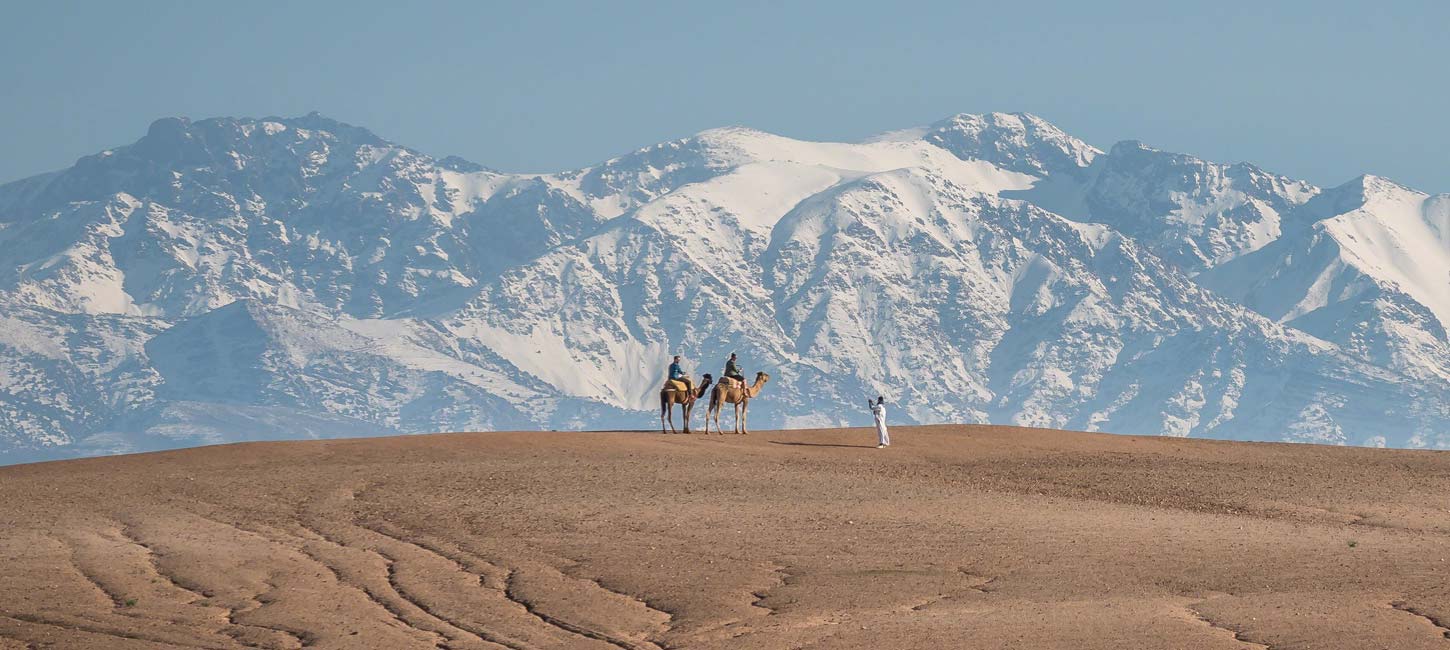
Agafay is a rocky stone desert — hamada — 30 km southwest of Marrakech, a 45-minute drive, on a plateau of marl hills beside the Lalla Takerkoust reservoir, with the Atlas Mountains on the horizon. It is not the Sahara and has no sand dunes; what it has is open space, silence, and golden light. Activities, with hotel pickup: the sunset camel ride from €29, quad biking from €50, the full-day trip with lunch and the lake from €55, the sunset camel ride with dinner from €65, and overnight glamping from €150. Best in spring and autumn, evenings only in summer, cold nights in winter. The right choice for an arrival or departure evening, families, and anyone without three days for the Sahara — all the tours are in the table below.
What Is the Agafay Desert?
Agafay is a hamada — a stone desert — on a plateau at 500–600 metres southwest of Marrakech, where the Haouz plain meets the first foothills of the Atlas. The hills that look lunar are marl: soft, pale sedimentary rock laid down under a Jurassic sea and eroded since into rounded, treeless badlands cut by dry riverbeds. That’s why the landscape is grey-gold rather than the red of the Sahara, why almost nothing grows on it, and why it turns to gold in low light — marl takes the sun like a screen. From the plateau the High Atlas runs along the whole southern horizon, snow-capped from December to April, with Toubkal, at 4,167 metres, visible on a clear day.
It isn’t the Sahara, it has no dunes, and it is 400 km from the nearest. What it offers is what the Sahara can’t in under three days: open horizon, silence, and the light — an hour from a riad in the Medina.

Lalla Takerkoust — The Lake in the Desert
The water you’ll see from every viewpoint is a reservoir. The French built the Lalla Takerkoust dam on the N’Fis river in 1935 to irrigate the Haouz plain, and the lake behind it — 7 km long when full, half that after dry years — is the only open water for fifty kilometres. It’s where the quad tours stop for mint tea, where the day trip lunches, and where Marrakech comes on a Sunday for a picnic, a pedalo, and in summer a jet ski; the restaurants along its northern shore grill lamb over the water. Above it, the Kik plateau rises to the Berber villages of the Atlas foothills, and twenty minutes on, Amizmiz holds the Tuesday souk — the most local market within reach of Marrakech.
How to Get There
30 km from the city centre, 45 minutes on the P2009, the paved Amizmiz road, past the Royal Golf and through the olive groves. By tour: every MDT Agafay product includes pickup and drop-off at your Marrakech hotel or riad, and most run as evening transfers. By car: a normal car reaches every camp on the paved road and the graded tracks; a 4×4 only for the riverbeds. By taxi: 300–400 MAD each way, with the return agreed before you leave — there are no taxis in Agafay. Phone signal is patchy on the plateau; set up a Moroccan SIM in the city first — our Morocco SIM card guide covers it.
Things to Do — With Real Prices
| Activity | When | From | Includes |
|---|---|---|---|
| Sunset Camel Ride in the Agafay Desert | Late afternoon, 3 hrs in all | €29 | Hotel pickup, a 1-hour camel ride into the hills, mint tea at a Berber tent, the sunset |
| Agafay Desert Quad Biking from Marrakech | Morning or afternoon, 3 hrs in all | €50 | Hotel pickup, 1–1.5 hrs on an automatic quad with a guide, helmet, tea at the lake |
| Agafay Desert Day Trip from Marrakech | Full day | €55 | Hotel pickup, the camel ride, lunch in a tent, Lalla Takerkoust lake, a Berber village |
| Agafay Desert Dinner & Sunset Camel Ride | Evening, 4–5 hrs in all | €65 | Hotel pickup, the camel at sunset, a three-course dinner at camp, music by the fire, the stars |
| Overnight glamping | 1 night | €150–400 | A tent with a real bed, dinner and breakfast; pool and ensuite at the upper tier; booked with the camp |
Every price includes the hotel pickup; none includes tips (20–50 MAD for the camel handler is right). The two most-booked are the sunset ride for a first evening and the dinner for a last one.

The Activities — What Each One Is Really Like
The sunset camel ride: the most-booked thing in Agafay and the right first evening in Morocco. Pickup at about four, the Amizmiz road, a Berber tent at the edge of the hills where the camels are saddled, then an hour at walking pace up a riverbed and over a ridge to a viewpoint as the light turns — the Atlas pink, the marl gold — mint tea and msemen in the tent after, and the city by eight. The camels are led by their handlers the whole way; children ride on a lap from two. Judge the outfit by the animals: how to tell a well-kept camel from a tired one is in our camel rides guide, and ours come from the same families every season.
Quad biking: an hour and a half on an automatic quad behind a guide, through the riverbeds and over the hills to the lake for tea — the one Agafay activity that covers ground, and the one where you see the scale of the plateau. Helmets, goggles, and a dust scarf provided; long trousers and closed shoes your side; drivers from 16, passengers behind an adult only. Morning in summer, afternoon the rest of the year; the dust is real, and so is the fun.
The day trip: the whole of Agafay in one day for a family or a first-timer — the camel ride, a village on the Kik plateau, lunch in a tent at a camp, the lake and its shore, back by late afternoon. Lunch is included on this one; the pace is a child’s.
Dinner under the stars: the camel at sunset, then a camp lit by lanterns — tagine, couscous, pastries, a fire, Gnawa or Berber musicians, and the sky. The romantic evening, the proposal evening, the last-night evening; the one our guests mention most in reviews. Vegetarian on request; alcohol at the camps that are licensed, so ask.
Glamping: a night in a tent with a real bed and a view, dinner and breakfast, and at the upper tier a pool, an ensuite, and a bath on the terrace. Camps are booked directly or through us; one night is the right length — the plateau is for the two hours of light, not a week.
Stargazing: honest, this time. Agafay is dark enough for a sky Marrakech never shows — the planets, the bright constellations, a satellite every few minutes — but the city’s glow sits on the northeastern horizon and the Milky Way in its full band is a Sahara thing, three days away. Good; not the desert sky of the photographs, which were taken at Erg Chebbi.

The Camps — And the Photograph Problem
La Pause opened in 2004 with a few tents and a view and was alone on the plateau for a decade; since about 2015 there are dozens of camps — Inara, Scarabeo, Agafay Luxury Camp, the Pause itself grown up, and a long tail of tented restaurants that open for the evening. They range from a Berber tent and a fire to a pool, a spa, and a bathtub on a wooden deck, and their photographs are the most-used images of Morocco on the internet.

The Two Hours of Light
Agafay is a light event. From midday to four the plateau is flat, pale, and hot, and a visitor who arrives then wonders what the fuss is; from an hour before sunset to an hour after, the marl turns gold, then rose, the Atlas goes violet, and the shadows draw the hills — and the place is as beautiful as anywhere in Morocco. Every good product is built around those two hours: the camel ride arrives at the viewpoint for them, the dinner starts in them, the balloon over the Haouz catches them at the other end of the day. If you can only give Agafay one slot, make it the hour before sunset — and if someone offers you a midday “desert tour,” know what you’re buying.
Best Time to Visit
Spring — March to May
25–30°C by day, 12–18°C at the sunset hour; snow still on the Atlas in March; the hills briefly green after rain.
Autumn — September to November
24–30°C, clear air, the longest golden hours; October is the month for the overnight.
Summer — June to August
35–42°C by day — sunset and evening tours only, the quad at 8 AM, the pool at the camps; the dinner evening is the summer Agafay.
Winter — December to February
18–22°C by day, 4–8°C after dark — the sharpest light of the year and the snow line on the Atlas; a jacket, a hat, and a blanket on the camel.
Month by month, for all of Morocco: our guide to the best time to visit Morocco.

Agafay vs the Sahara — Which Desert?
| Feature | Agafay | Sahara (Erg Chebbi, Merzouga) |
|---|---|---|
| Distance | 30 km — 45 minutes | 560 km — 9–10 hours, a 3-day tour |
| Landscape | Stone desert: marl hills, dry riverbeds, the Atlas behind | Sand dunes to 150 metres |
| Time needed | An evening, a half day, or one night | Three days minimum; four is better |
| Camel ride | ✅ 1 hour, from €29 | ✅ Sunset trek to the camp and back at sunrise, included |
| Camp | Glamping at €150–400, or a tented dinner | Included in the tour, in three tiers |
| Night sky | Good — the city’s glow on one horizon | ⭐ Exceptional — the Milky Way |
| Cost | From €29 an activity, €55 a day | From €95 shared, €195 private, 3 days |
| Best for | A first or last evening, families, a quick escape, an event | The bucket list, photographers, honeymoons |
The advice we give daily: an evening or a half day, Agafay; three days or more, the Sahara; both if you can — the Agafay dinner on the first evening and the Merzouga tour from the next morning is the best week in Morocco. Three deserts side by side, including Zagora, in our Agafay vs Merzouga vs Zagora guide; every Sahara route and price in our Sahara planning guide.
Nearby & Combinations
The Ourika Valley — green where Agafay is bare: the river, the Berber villages, the Setti Fatma falls, 60 km east; our Ourika Valley guide covers it.
The Atlas Mountains — Imlil and the Three Valleys, 90 minutes south: a mountains-in-the-morning, desert-at-sunset day is possible on the Atlas Mountains Day Trip from Marrakech with the Agafay dinner after, and the whole range is in our Atlas Mountains guide.
Lalla Takerkoust — ten minutes from the camps, for the shore restaurants and the water. Amizmiz — twenty minutes on, for the Tuesday souk.
And every day trip from the city, compared by time on site, is in our best day trips from Marrakech guide.
What to Bring
- Clothing: light layers by day and a warm jacket for the evening — the plateau drops 10–15°C after sunset in every season; closed shoes for the rocks and the camel; long trousers for the quad.
- Sun: a hat, sunglasses, SPF 50 — there is no shade outside the tents.
- Tech: a camera and a wide lens if you have one, a power bank, offline maps.
- Cash: dirhams in small notes for tips and the lakeside tea; there’s no ATM past the city.
The full list, for the Sahara too: what to pack for a Morocco desert tour.

Practical Tips
Book 24 hours ahead — the sunset slots sell out in spring, autumn, and the holidays; same-day is sometimes possible on WhatsApp.
What’s included on every MDT Agafay product: the Marrakech hotel pickup and return, the activity, tea, and the guide; tips are yours (20–50 MAD a handler).
Photography: the hour before sunset, a wide lens, and the camel against the Atlas; drones need a permit in Morocco and are refused at the camps.
Families: children on a parent’s lap on the camel from two, their own saddle from six; no children on the quads as drivers, and passengers only behind an adult.
Dress: anything; a scarf for the quad’s dust and the evening’s wind.
Where: 30 km and 45 minutes southwest of Marrakech — a stone desert of marl hills, no sand, the Atlas behind, a reservoir in the middle.
Activities: The sunset camel ride €29, the quad €50, the day trip with lunch €55, the dinner evening €65, glamping from €150 — all with hotel pickup.
The light: The hour before sunset and the hour after; nothing much at midday.
The camps: The tent in the photograph is the €300 one — book the evening you want.
Seasons: Spring and autumn; evenings only in summer; a jacket in winter.
Versus the Sahara: An evening here, three days there — both if you can.