
- Visa: 90 days visa-free for the UK, US, EU, Canada, Australia, and New Zealand; a passport valid six months; an e-visa for most others.
- Money: the Moroccan dirham (MAD) — buy it on arrival, not abroad; ATMs everywhere; cash in the Medinas; withdraw 1,900, not 2,000, to get notes you can spend.
- Flights: Marrakech (RAK) for tours, Casablanca (CMN) for the widest connections; the trains link the cities.
- Health: no vaccinations required, no malaria, bottled water, a pharmacy on every block.
- Budget: €30–40 a day on a budget, €60–100 mid-range, from €150 luxury.
- Time: GMT all year — no daylight saving, no Ramadan switch.
- Best months: spring and autumn.
- Tours: desert tours from €69, day trips from €17, Atlas treks from €125 — the hubs are below.
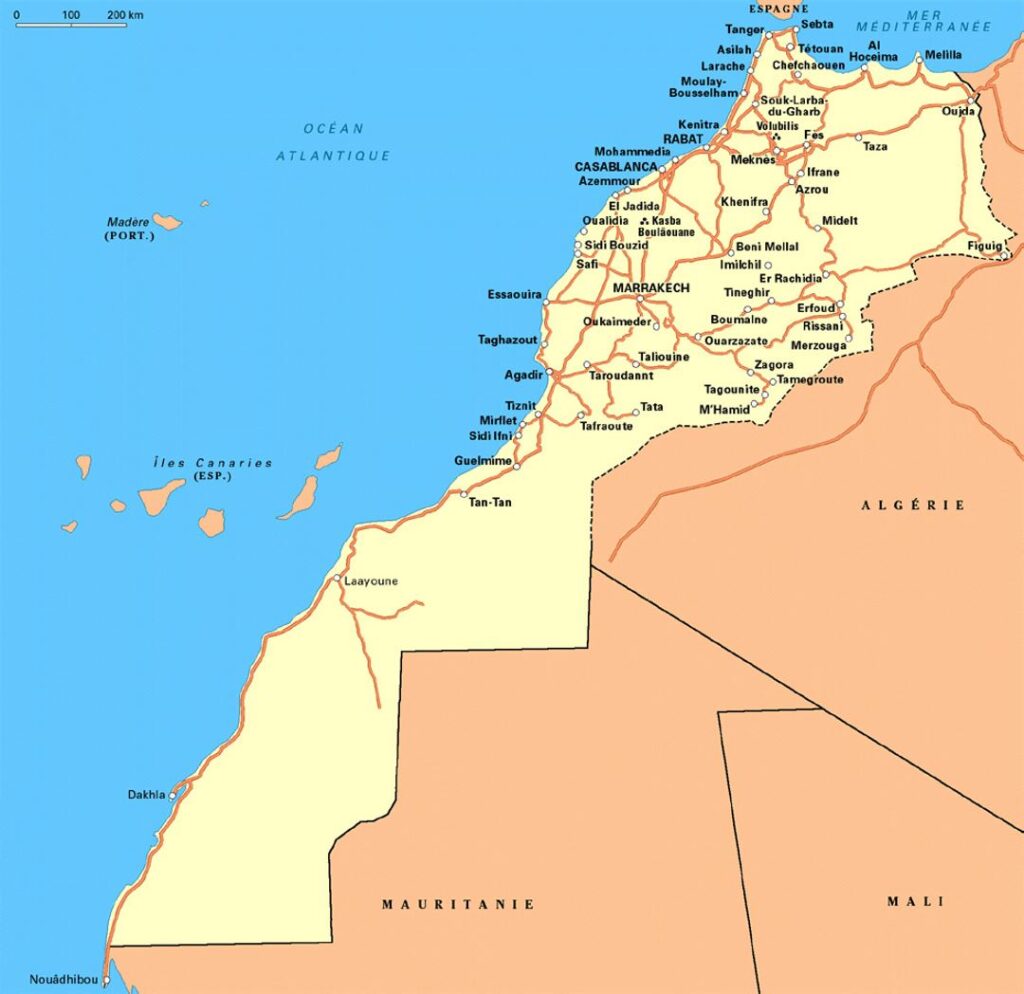
Morocco at a Glance
| Fact | Detail |
|---|---|
| Capitals | Rabat (political) · Casablanca (economic) · Marrakech (tourism) |
| Population | 36.8 million (2024 census), 63% urban; median age about 29 |
| Languages | Arabic and Amazigh (official); French everywhere in business and on signs; Spanish in the north; English in tourism |
| Religion | About 99% Muslim; a Christian minority; a Jewish community of around 2,500, mostly in Casablanca |
| Currency | Moroccan dirham (MAD), 100 centimes; about 10.5–11 MAD to the euro, 10 to the US dollar |
| Time zone | GMT all year — no daylight saving (the same as London in winter, an hour behind it in summer) |
| Electricity | 220 V, Type C and E (European two-pin); UK and US plugs need an adapter |
| Emergency | Police 19 · Ambulance and fire 15 · Gendarmerie (rural roads) 177 |
| Visa | 90 days visa-free for the UK, US, EU, Canada, Australia, New Zealand; e-visa for others |
| Drinking water | Bottled or filtered; tap water is chlorinated in the cities and fine for teeth |
| Weekend | Saturday and Sunday for offices; Friday midday for prayers, when shops close for two hours |
| Best season | Spring (March–May) and autumn (September–November) |
Visa & Entry
Citizens of the UK, Ireland, the US, Canada, Australia, New Zealand, and every EU country enter visa-free for up to 90 days, on a passport valid for at least six months. On the plane or at the desk you fill in a short arrival form — name, profession, address in Morocco — and the officer stamps a number in your passport that you’ll quote at every hotel. Keep the passport with you on day trips and tours: the gendarmerie checkpoints on the desert roads ask for it, and a photocopy satisfies most of them.
Nationalities that need a visa — South Africans, Indians, and others — can apply online through Morocco’s e-visa portal, Accès Maroc, launched in 2022, which issues an electronic travel authorisation in about three working days for a 30-day stay; a consulate visa is the alternative. Rules and the eligible list change; the official source is the Moroccan consulate for your country, and it’s worth a check in the week before you fly.
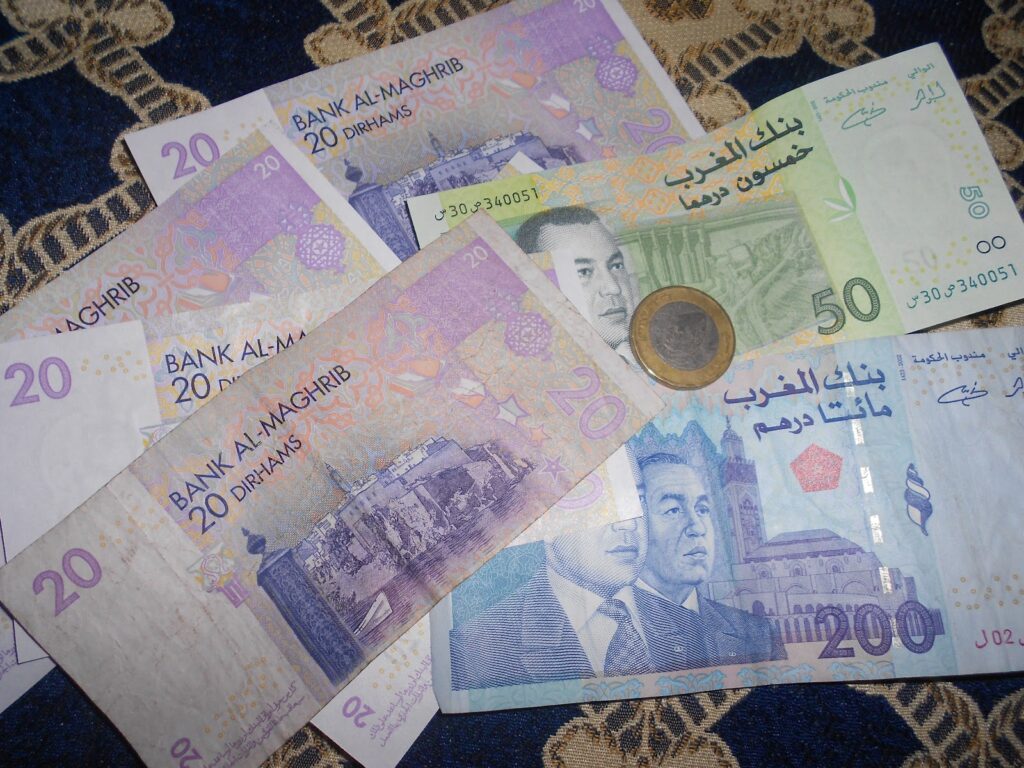
Money — The Dirham, the ATM, and the 200 Problem
The dirham is a restricted currency: you can’t buy it from a bank abroad, and you may carry no more than 2,000 MAD in or out — which means you arrive with euros, dollars, or pounds, or with a card, and change or withdraw on arrival. Both work. The airport exchange desks are fine now — Morocco’s rates are set within a narrow band, so the airport is within a point of the town bureaus — and the ATMs of the big banks (Attijariwafa, BMCE, Banque Populaire, CIH) are at every airport and on every main street, with a withdrawal limit of 2,000–3,000 MAD and a fee of about 30 MAD on top of your own bank’s.
Cards are accepted in hotels, the larger restaurants, and the new towns; the Medina, the souks, the day-trip lunches, and every entrance fee are cash. When a card machine asks whether to charge in euros or dirhams, choose dirhams — the “convenient” euro option is dynamic currency conversion at 5–8% against you. Before you fly home, spend or re-exchange your dirhams at the airport bureau with your original exchange receipt; the leftover notes are worth nothing abroad.
Tipping, in dirhams: restaurants 10%; cafés, round up; a driver 50–100 MAD a day on a multi-day tour, 30–50 on a day trip; a guide 100–150 a day; a camel handler 20–50; a porter 10–20 a bag; a hammam attendant 20–30. It’s part of the economy, expected, and small; carry the notes for it.
Getting to Morocco — Flights & Airports
Two airports matter: Marrakech Menara (RAK), ten minutes from the Medina and the right choice for desert tours, treks, and day trips, with direct flights from most European cities on the budget airlines and the flag carriers; and Casablanca Mohammed V (CMN), the hub with the long-haul connections — Royal Air Maroc from New York, Washington, Miami, Toronto, Montreal, and the Gulf — and a 2h40 train to Marrakech. Fes (FEZ), Tangier (TNG), and Agadir (AGA) have European routes too. From Australia and New Zealand it’s a connection in Europe or the Gulf. Fares peak at Christmas and New Year, Easter, and July–August; book those three months out.
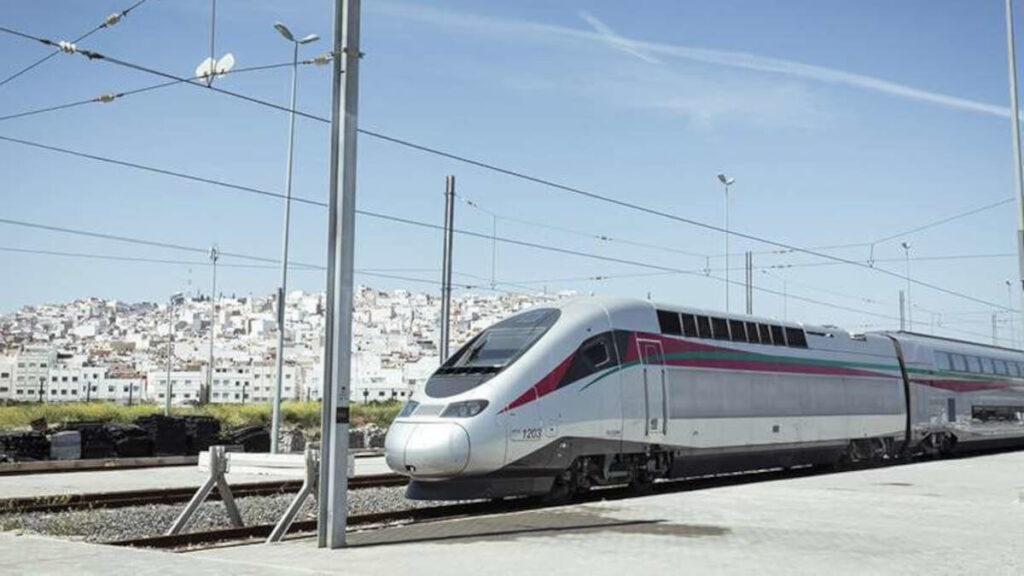
Getting Around — Trains, Buses, Taxis
Morocco has the best trains in Africa and most visitors never use them. The ONCF network links Marrakech, Casablanca, Rabat, Kenitra, Meknes, Fes, and Tangier; the Al Boraq high-speed line runs Tangier–Casablanca in 2h10 and is being extended to Marrakech for 2030. Tickets on the ONCF app or at the station; first class is worth the few extra dirhams for a reserved seat.
| Route | Time | Price (2nd / 1st class) |
|---|---|---|
| Marrakech – Casablanca | 2h40 | ~110 / 170 MAD |
| Casablanca – Rabat | 1h | ~50 / 80 MAD |
| Casablanca – Tangier (Al Boraq) | 2h10 | ~200 / 350 MAD |
| Casablanca – Fes | 3h30 | ~130 / 200 MAD |
| Marrakech – Fes | ~7h, via Casablanca | ~200 / 300 MAD |
| Airport (CMN) – Casa Port | 35 min | ~50 MAD |
Buses: CTM and Supratours run air-conditioned coaches to everywhere the trains don’t — Essaouira (3 h, ~80 MAD), Chefchaouen from Fes (4 h, ~75 MAD), Ouarzazate, Zagora, Merzouga — bookable online, reliable, and the way to the south if you’re not on a tour.
Grand taxis: the white Mercedes and vans that run fixed routes between towns from a rank, six passengers to a car, departing when full, at fixed fares of 20–100 MAD a seat.
Petit taxis: the small city cabs, colour-coded by city — red in Casablanca, beige in Marrakech, red in Fes — metered by law; insist on the meter, 15–40 MAD across a city centre. Ride apps: Careem, inDrive, Heetch, and Yango work in the big cities. Driving: the roads are good and the driving is not — a hire car makes sense for the coast and the north, not for the Atlas passes or the Medinas. For the desert, the mountains, and the day trips, a tour includes the transport, the driver, and the pickup, which is the point.
Health
No vaccinations are required to enter Morocco, and the country has been certified malaria-free by the WHO since 2010 — no tablets, no nets. The routine jabs (tetanus, polio, MMR) should be current; hepatitis A and typhoid are sensible for a long stay, rabies only if you’ll be far from a city for weeks. The real health risks are the ordinary ones: the sun and dehydration in summer, a stomach adjusting to a new diet in the first two days, and the roads.
Water: bottled is 5 MAD everywhere and the riad fills your bottles; the city tap water is chlorinated and fine for brushing teeth. Pharmacies — the green cross — are on every block, open late, with a pharmacist who speaks French and usually English and dispenses most things without a prescription; every town has a pharmacie de garde open through the night, listed on every pharmacy door. Hospitals: the private clinics in Marrakech, Casablanca, and Rabat are good and expect payment; travel insurance that covers private care and medical evacuation is the one document to have. Street dogs are common and usually indifferent; don’t touch them, and see a pharmacist the same day if one bites.
Safety — The Short Version
Morocco is a safe country for visitors, with a crime profile of petty theft and persistent hustle rather than violence: pickpockets in the Medina crowds and at the stations, the “that way is closed” touts, the unlicensed “guide” who wants paying, the carpet-shop pressure, the taxi without a meter. The habits that handle all of them: a bag in front, small notes, a firm la shukran, the willingness to walk away, and licensed guides only — the brass badge, booked through a hotel or an operator. Our guide to whether Casablanca is safe goes neighbourhood by neighbourhood and covers the rules for women and LGBTQ+ travellers; for the Marrakech Medina, the Guided Marrakech Walking Tour on your first morning is the fix for the touts — after three hours with a licensed guide the labyrinth stops being one.
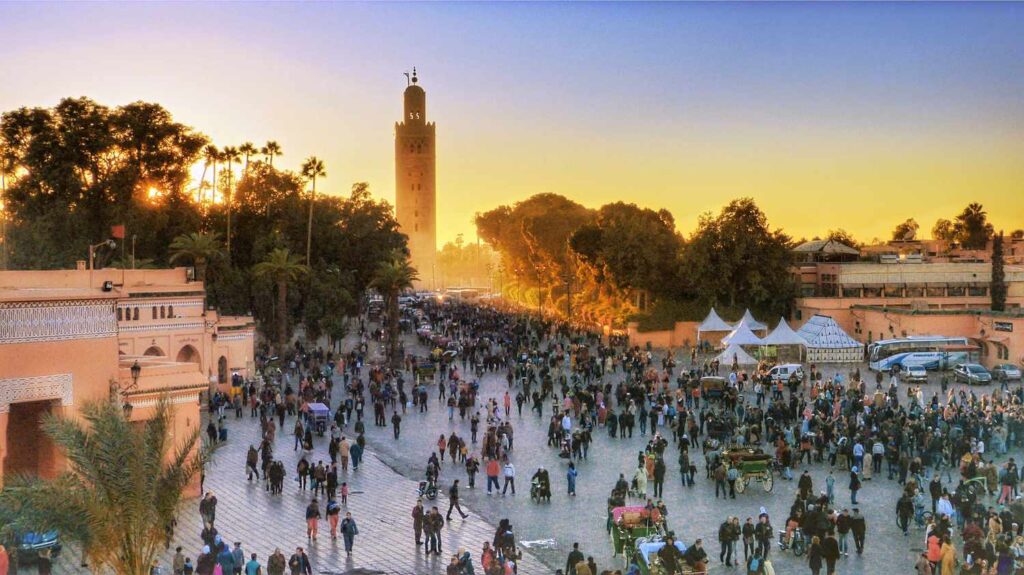
What Morocco Costs — Three Budgets
| Category | Budget | Mid-range | Luxury |
|---|---|---|---|
| A night | €15–30 — hostel, simple dar | €60–120 — a good riad | €150–600 — a restored riad, a palace hotel |
| Meals | 30–60 MAD a plate — local restaurants, the square | 80–150 MAD — Medina courtyards, the new town | 200–500 MAD — fine dining, a riad’s set dinner |
| Street food | 5–40 MAD — Msemen, Harira, Kebabs, juice | ||
| Transport | 20–100 MAD — grand taxis, buses | 110–350 MAD — trains, first class | 400–800 MAD a day — a car and driver |
| Mint tea / coffee | 10–15 MAD | ||
| SIM and data | 50–100 MAD for the trip | ||
| Entrance fees | 20–100 MAD a site; the Hassan II Mosque 130 | ||
| Tours | Day trips from €17; the Sahara from €69 | Private day trips from €25; the Sahara from €105 | Private multi-day from €195; the 4-day from €275 |
| A day, all in | €30–40 | €60–100 | €150 and up |
Ramadan — And the Dates That Close Things
Morocco keeps GMT all year — no daylight saving — so your phone, the trains, and the pickups agree, and a printed schedule is as good as a live one. What changes the day is Ramadan: cafés close or curtain until sunset, the souks run late into the night, the hotels and tourist restaurants serve as normal, and eating in the street by day is poor manners. It’s a fascinating time to be here, and a slower one — our guide to visiting Morocco during Ramadan has the whole picture.
Explore Morocco — Destination Guides
This page covers the practical essentials. For deep destination guides, food, culture, and activities, see our dedicated pages:
| Topic | Guide |
|---|---|
| When to visit | Best Time to Visit Morocco — month-by-month → |
| Sahara desert | Sahara Planning Guide → |
| Which desert? | Agafay vs Merzouga vs Zagora → |
| Moroccan food | Moroccan Food Guide — 20 dishes, prices, where to eat → |
| Culture & etiquette | Morocco Culture & Etiquette Guide → |
| Marrakech | Marrakech Souks Guide → |
| Fes | Things to Do in Fes → |
| Essaouira | Essaouira Travel Guide → |
| Chefchaouen | Chefchaouen Travel Guide → |
| Atlas Mountains | Atlas Mountains Guide → |
| Riads | What Is a Riad? → |
| Berber culture | Berber Culture Guide → |
| Ramadan | Visiting During Ramadan → |
| Alcohol | Alcohol in Morocco → |
| What Morocco is famous for | 20 Things Morocco Is Known For → |
| SIM card | Best SIM Card for Morocco → |
Explore Morocco — The Guides
This page is the practical layer; the depth is in the guides it points to:
| Topic | Guide |
|---|---|
| When to visit | Best Time to Visit Morocco — month by month |
| Where to stay | What Is a Riad? |
| Staying connected | Best SIM Card in Morocco |
| What to pack | What to Pack for a Morocco Desert Tour |
| The Sahara | How to Plan a Sahara Desert Trip |
| Which desert | Agafay vs Merzouga vs Zagora |
| Food | Moroccan Food Guide |
| Culture | Morocco Culture & Etiquette |
| Alcohol | Alcohol in Morocco |
| Marrakech | Things to Do in Marrakech |
| The souks | Marrakech Souks Guide |
| Fes | Things to Do in Fes |
| Essaouira | Essaouira Travel Guide |
| Chefchaouen | Chefchaouen Travel Guide |
| The Atlas | Atlas Mountains Guide |
| Berber culture | Who Are the Berbers of Morocco? |
| Day trips | Best Day Trips from Marrakech |
MDT Tours — Where to Start
| What you want | Hub or tour | From |
|---|---|---|
| Every day trip from Marrakech | Day Trips from Marrakech | €17 |
| Toubkal and the Atlas treks | Atlas Mountains Trekking | €125 |
| The classic Sahara | Shared 3-Day Marrakech to Merzouga Desert Tour | €95 |
| The desert in two days | Shared 2-Day Marrakech to Zagora Desert Tour | €69 |
| The coast in a day | Essaouira Day Trip from Marrakech | €19 |
| The UNESCO ksar in a day | Ouarzazate & Aït Ben Haddou Day Trip | €23 |
Visa: 90 days visa-free for most Western passports, six months’ validity, the e-visa for others.
Money: Dirhams on arrival, cash in the Medinas, withdraw 900 or 1,900 to dodge the 200-dirham problem, pay in dirhams not euros on the card machine.
Getting there: Marrakech for tours, Casablanca for connections, the train between them in 2h40.
Health: No jabs required, no malaria, a pharmacy on every block, insurance for the private clinics.
Time: GMT+1 — except Ramadan, when the clocks go back.
Dates: The two Eids close the country for two days each; no camp on New Year’s Eve.
Words: La shukran and safi end most conversations; bla hrur fixes most meals.
Budget: €30–40 a day works; €60–100 is comfortable.