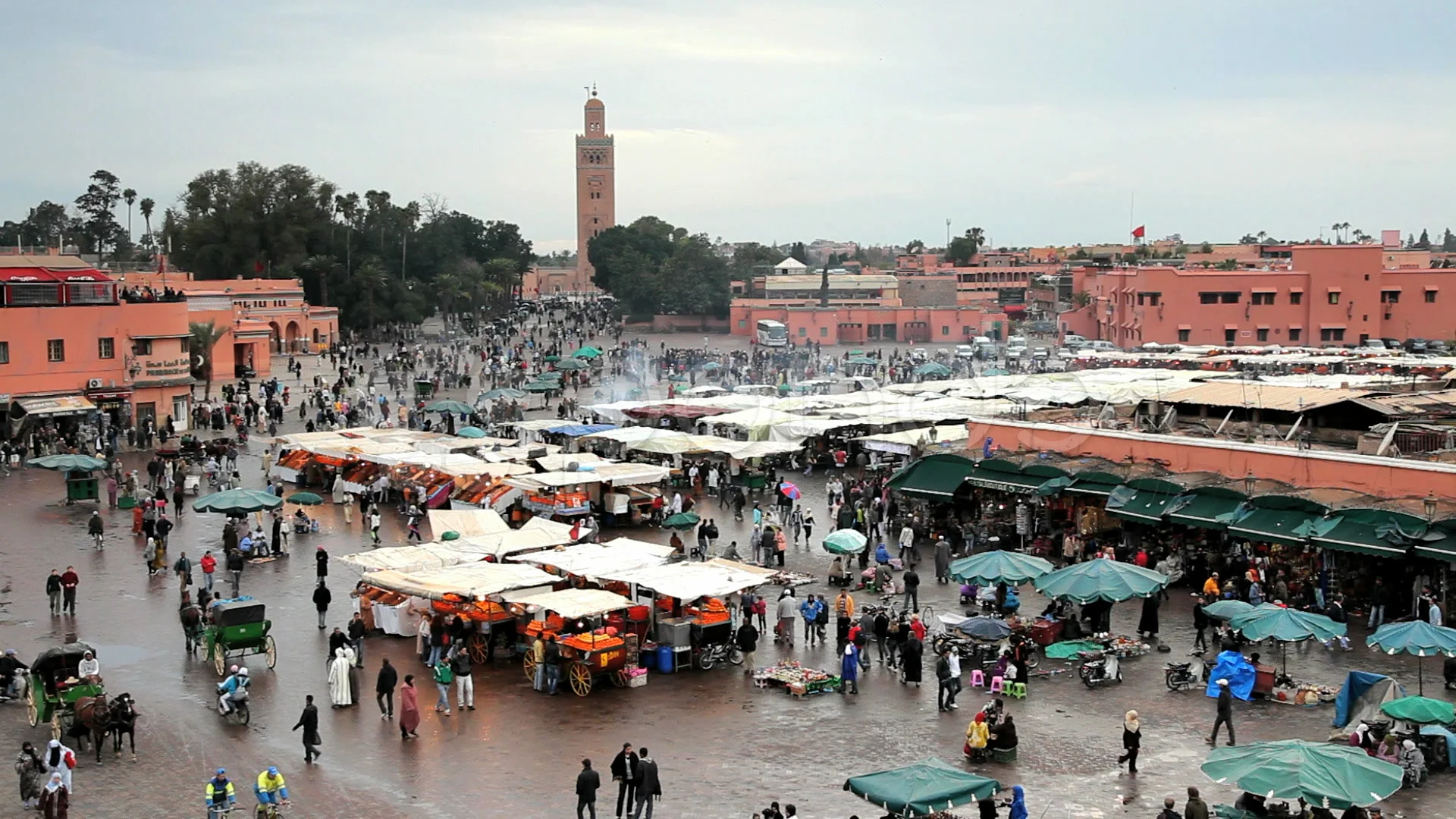
- Jemaa el-Fna — the square, free; best at dusk
- Koutoubia Mosque — the 77 m minaret, exterior only, free
- Bahia Palace — ~100 MAD
- Saadian Tombs — ~100 MAD
- Ben Youssef Madrasa — ~80 MAD
- Majorelle Garden & the YSL Museum — ~170 + ~140 MAD
- El Badi Palace — ~100 MAD
- The souks — free
- A hammam — 150–400 MAD
- The Mellah and the Jewish cemetery — free, tip the caretaker
Best in three to four days; the walking tour, the camel ride, the balloon, and every day trip are in the tables below.
20 Best Things to Do
Every attraction below is in or near the medina unless noted. Entry fees are the tariffs for foreign visitors as of November 2026 — Moroccan residents pay less; carry cash, most ticket desks don’t take cards. Most sites take 30–90 minutes.
| # | Attraction | Type | Time | Entry |
|---|---|---|---|---|
| 1 | Jemaa el-Fna | Square · UNESCO intangible heritage | Any time (best at dusk) | Free |
| 2 | Koutoubia Mosque | Mosque · landmark | Exterior only | Free |
| 3 | Bahia Palace | Palace · 19th C | 1–1.5 hrs | ~100 MAD |
| 4 | Saadian Tombs | Mausoleum · 16th C | 30–45 min | ~100 MAD |
| 5 | Ben Youssef Madrasa | Qur’anic college · 1565 | 30–45 min | ~80 MAD |
| 6 | Majorelle Garden + Musée YSL | Garden · museum | 1.5–2 hrs | ~170 + ~140 MAD |
| 7 | El Badi Palace | Palace ruin · 16th C | 45 min–1 hr | ~100 MAD |
| 8 | Medina souks | Markets | 2–4 hrs | Free |
| 9 | Hammam | Steam bath | 1–2 hrs | ~150–400 MAD |
| 10 | Mellah + Jewish Cemetery | Historic quarter | 1 hr | Free (tip ~20 MAD) |
| 11 | Dar El Bacha — Musée des Confluences | Museum · palace | 45 min | ~60 MAD |
| 12 | Le Jardin Secret | Garden · 16th C riad | 45 min | ~80 MAD |
| 13 | Tanneries (Bab Debbagh) | Traditional craft | 30 min | Free (tip the guide) |
| 14 | Maison de la Photographie | Museum | 30–45 min | ~50 MAD |
| 15 | Rooftop dining (Nomad, Le Jardin) | Restaurant | 1–2 hrs | ~80–200 MAD |
| 16 | Rahba Kedima — the spice square | Market | 30 min | Free |
| 17 | Cooking class | Experience | 3–4 hrs | ~300–500 MAD |
| 18 | Bab El Khemis flea market (Thursdays) | Market | 1–2 hrs | Free |
| 19 | Hot air balloon at sunrise | Adventure | 3 hrs incl. transfer | €165 (MDT) |
| 20 | Guided walking tour | Tour | 3 hrs | €20 (MDT) |

Landmarks & Palaces
Koutoubia Mosque: Marrakech’s defining landmark — the 77-metre Almohad minaret, finished around 1195, is visible from across the city and is the orientation point for the whole medina; its design was the model for the Giralda in Seville. Non-Muslims can’t enter, but the exterior, the rose gardens, and the floodlit silhouette after dark are the icon. Free. Best photographed from the rooftop cafés on Jemaa el-Fna.
Bahia Palace: a sprawling 19th-century palace built for Grand Vizier Si Moussa and enlarged by his son Ba Ahmed — 150 rooms, zellige tilework, painted cedar ceilings, and a courtyard of orange trees, built for a harem of four wives and twenty-four concubines, which is why the rooms are all the same size. One of Marrakech’s best-preserved interiors. ~100 MAD. Allow 1–1.5 hours; go at opening.
El Badi Palace: the dramatic ruins of Sultan Ahmad al-Mansur’s 16th-century palace — once clad in Italian marble and gold, stripped a century later by Moulay Ismail to build Meknes. A vast, atmospheric ruin now, with sunken orange gardens, a pool the length of a football pitch, and storks nesting on every wall. Climb the rooftop for the medina view; the original Koutoubia minbar, a 12th-century masterpiece from Córdoba, is in a side room. ~100 MAD.
Saadian Tombs: sealed up by Moulay Ismail in the 17th century and rediscovered from an aerial photograph in 1917, the 16th-century mausoleum of the Saadian dynasty holds Ahmad al-Mansur and sixty of his family under the Chamber of the Twelve Columns — Carrara marble, gilded cedar, zellige. A small site with a queue for the one doorway; go at opening. ~100 MAD.
Ben Youssef Madrasa: founded by the Merinids in the 14th century and rebuilt by the Saadians in 1565, this was the largest Qur’anic college in North Africa — 130 student cells around a courtyard of carved cedar, stucco, and zellige that is the finest single interior in the city. Reopened in 2022 after a four-year restoration. ~80 MAD.
City walls and gates: the ochre ramparts encircling the medina run 19 km and date to 1126, when the Almoravids walled their new capital. Walk or cycle a section at sunset; of the gates, Bab Agnaou, the Almohad royal gate beside the Kasbah Mosque, is the one to see, and Bab Debbagh leads to the tanneries.

Museums & Gardens
Majorelle Garden & Musée YSL: created by the French painter Jacques Majorelle from 1923 and opened to the public in 1947, the garden was bought and saved from developers by Yves Saint Laurent and Pierre Bergé in 1980 — Saint Laurent’s ashes were scattered here. The cobalt villa, cactus, bamboo, and lily ponds are the most photographed corner of the city; the Berber Museum inside the villa is the surprise. Next door, the Musée Yves Saint Laurent (2017) shows the couture and the Marrakech that inspired it. Garden ~170 MAD, museum ~140 MAD, a combined ticket at a saving; book online for a timed slot and go at opening — by ten it’s a queue.
Dar El Bacha — Musée des Confluences: the 1910 palace of Thami El Glaoui, the Pasha of Marrakech, where Churchill and Roosevelt were his guests — restored to the finest zellige and painted cedar in the city and now a museum of rotating exhibitions on the civilisations of the Mediterranean and beyond. The building is the exhibit; Bacha Coffee in the courtyard, with 200 single-origin coffees, is the city’s most elegant pause. ~60 MAD.
Le Jardin Secret: a 16th-century Saadian riad and its two gardens — one exotic, one Islamic, laid out on the geometry of paradise — restored and opened in 2016, with a tower that gives the best close view of the medina rooftops. The irrigation here is the original khettara channel, explained in the small exhibition. ~80 MAD.
Maison de la Photographie: 10,000 photographs of Morocco from the 1870s to the 1950s — Berber villages, the first tourists, the city before the Protectorate — in a restored riad with a rooftop café. The quietest museum in the medina. ~50 MAD.
The Menara and the Agdal: two Almohad gardens from the 12th century, both still irrigated as they were built. The Menara, 3 km west of the medina, is the olive grove and the pavilion reflected in its reservoir with the Atlas behind — the city’s postcard, free, best at sunset. The Agdal, south of the royal palace, is 400 hectares of orchards and the oldest working garden in the Islamic world; open only on Fridays and Sundays, free.
Medina Experiences

Medina Experiences
Jemaa el-Fna: the square is listed by UNESCO not as a monument but as living culture — the first place in the world proclaimed a Masterpiece of the Oral and Intangible Heritage of Humanity, in 2001 — and what the listing protects is the halqa, the storytelling circle, with its musicians, Gnawa players, acrobats, and herbalists. Morning: juice vendors and henna artists; afternoon: the performers; evening: a hundred food stalls — grilled meats, harira, snails, the orange juice at about 10 MAD. Free. Watch from the rooftops of Café de France or Le Grand Balcon at sunset. Two honest notes: the snake charmers and monkey handlers are the one tradition we’d rather you didn’t fund — the animals are badly kept — and any photo of a performer costs 20 MAD, agreed before you raise the phone.
The souks: the labyrinth north of the square — textiles, lanterns, spices, leather, ceramics, and the workshops that make them. Start at Souk Semmarine, the main artery, and work outward to the dyers’ souk, the blacksmiths, and the carpet dealers; the fondouks — the medieval trading inns around Mouassine, Fondouk Kharbouch and Fondouk el-Amri among them — still house working artisans in their courtyards. The full guide, with bargaining tips and what things should cost, is our Marrakech souks guide.
The Mellah: the Jewish quarter, founded in 1558 when the Saadians moved the community beside the royal palace, was home to 40,000 people in the 1940s; a few hundred remain. The Lazama Synagogue, still active, and the Jewish cemetery — the largest in Morocco, whitewashed tombs under the sun — are the two visits; the quarter’s spice souk and jewellers are the daily life. Free (tip the cemetery caretaker ~20 MAD).
The tanneries: at Bab Debbagh, on the eastern edge of the medina, hides are still soaked, limed, and dyed in open pits the way they were a thousand years ago — colourful and pungent. A guide will hand you mint to hold under your nose and expect you to browse his terrace shop afterwards; agree a tip (20–50 MAD) before you go in, and go in the morning when the work is happening.
Rahba Kedima: the old grain square turned spice square — saffron, cumin, ras el hanout, argan oil, and the apothecaries’ stalls with their dried chameleons and remedies — ringed by the terraces of Nomad and Café des Épices. The calmest place in the souks to buy spices.

Experiences
Hammam: the steam bath is the city’s ritual — black soap, a scrub with the kessa glove that takes off a layer you didn’t know you had, a rinse, and optionally a massage. Local hammams (public, single-sex, 20–50 MAD, bring your own soap and glove) are the real thing and the better story; tourist hammams (150–400 MAD) add a robe, mint tea, and privacy; the spa at La Mamounia is the splurge. Allow 1–2 hours, and don’t eat first.
Rooftop dining: Marrakech eats on its roofs. Nomad over Rahba Kedima for modern Moroccan, Le Jardin for its courtyard, the Jemaa el-Fna terraces for the sunset, Le Salama or Kabana for a drink with the Koutoubia in view — budget 80–200 MAD a head for a meal with the view. Dinner on the square itself, at the stalls, is the cheaper and louder option.
Cooking class: tagine, pastilla, or msemen with a dada — a traditional cook — usually starting with the shopping in the souk. Half a day, 300–500 MAD, and the one souvenir that works at home. What you’ll be cooking, and why, is in our Moroccan cuisine guide.
The Palmeraie: the 13,000-hectare palm grove north of the city — a khettara creation, 100,000 trees — is where Marrakech goes for its desert-at-the-door experiences. The Camel Ride in the Marrakech Palmeraie, an hour at sunset with mint tea, from €25, is the gentle one; Quad Biking in the Marrakech Palmeraie is the loud one; both include hotel pickup and are a 20-minute transfer from the medina.
Hot air balloon: at dawn, over the palmeraie and the Jbilet hills with the Atlas on the horizon — the khettara lines below you, the snow above — then a Berber breakfast in a tent. The Sunrise Hot Air Balloon Ride in Marrakech, from €165, includes the hotel pickup and the three hours it takes.
Music and festivals: Gnawa, Amazigh, and Andalusian music play nightly on the square and in the riads; the Théâtre Royal in Gueliz stages concerts, and the National Festival of Popular Arts, in early July, fills the El Badi ruins and the square with troupes from every region — the one week a year the city performs for itself.
Gueliz: the French-built new town, a twenty-minute walk or a 20 MAD taxi from the square — Art Deco façades on Avenue Mohammed V, the galleries, the wine bars, the Comptoir Darna dinner show, and the murals of the MB6 street-art project. Marrakech’s other half, and where Marrakchis spend their evenings.

Suggested Itinerary
1 day: Jemaa el-Fna at breakfast → the Koutoubia gardens → the Bahia Palace → the souks and Rahba Kedima → a rooftop dinner over the square.
2 days: Day 1 as above. Day 2: the Majorelle Garden and the YSL Museum at opening → the Saadian Tombs → the Mellah and the Jewish cemetery → a hammam → the Menara at sunset.
3–4 days: Days 1–2. Day 3: the Ben Youssef Madrasa → Le Jardin Secret → El Badi → Dar El Bacha and a coffee → a cooking class or the balloon at dawn. Day 4: a day trip — Essaouira, the Atlas valleys, Ouzoud, or Aït Ben Haddou — or the Palmeraie at sunset.

Beyond the City — Day Trip Destinations
Marrakech is the gateway to Morocco’s best day trips — the coast, two mountain valleys, a waterfall, and a UNESCO kasbah all within three and a half hours. Each destination has its own guide:
| Destination | Distance | Shared trip from | Guide |
|---|---|---|---|
| Essaouira | 190 km / 2.5 hrs | €19 | Essaouira day trip guide |
| Ourika Valley | 60 km / 1.5 hrs | €17 | Ourika Valley guide |
| Ouzoud Waterfalls | 150 km / 2.5 hrs | €19 | Ouzoud Waterfalls guide |
| Aït Ben Haddou & Ouarzazate | 180 km / 3.5 hrs | €23 | Aït Ben Haddou guide |
| Atlas Mountains (Imlil, the Three Valleys) | 60 km / 1–1.5 hrs | €50 | Atlas Mountains guide |
MDT Tours from Marrakech
MDT Tours from Marrakech
| Tour | Duration | From |
|---|---|---|
| Guided Marrakech Walking Tour | 3 hrs | €20 |
| Sunrise Hot Air Balloon Ride in Marrakech | 3 hrs | €165 |
| Sunset Camel Ride in the Agafay Desert | Half day | €29 |
| Shared Ourika Valley Day Trip from Marrakech | 1 day | €17 |
| Essaouira Day Trip from Marrakech | 1 day | €19 |
| Shared 2-Day Marrakech to Zagora Desert Tour | 2 days | €69 |
| Shared 3-Day Marrakech to Merzouga Desert Tour | 3 days | €95 |
Top five: Jemaa el-Fna, the Koutoubia (exterior), the Bahia Palace, the Saadian Tombs, the Majorelle Garden.
Fees: Most big sites charge foreign visitors a modest entry fee; cash only at most doors.
Hidden gems: The Menara at sunset, the Agdal on a Friday, Le Jardin Secret’s tower, the Mellah, the Thursday market at Bab El Khemis.
Only here: The khettaras, the seven saints, Jemaa el-Fna’s 2001 listing.
Experiences: A hammam, a cooking class, the sunrise balloon, the Palmeraie camel ride.
Time: One day minimum, three or four ideal, with a day trip on the last.