
Morocco is an Arab-Amazigh (Berber) country, Muslim, multilingual — Darija, Tamazight, French, and English in the cities — and built on hospitality. The rules: greet before anything else (salam alaikum, a handshake, a hand to the heart); accept the tea; take your shoes off at the door of a home; eat with the right hand and bread; dress modestly away from the beach and the hotel — shoulders and knees; ask before photographing a person; don't enter mosques except the Hassan II in Casablanca; don't eat in the street by day in Ramadan; tip in dirhams — 10% in restaurants, 100 MAD a day for a guide, 100–200 MAD a day for a driver. The hustle in the Medina is commerce, not hostility: la shukran and a smile end it. Morocco is safe for visitors with ordinary city sense; the detail is in the guides linked below.
Who Are the Moroccan People?
Who Moroccans Are — The Amazigh Question
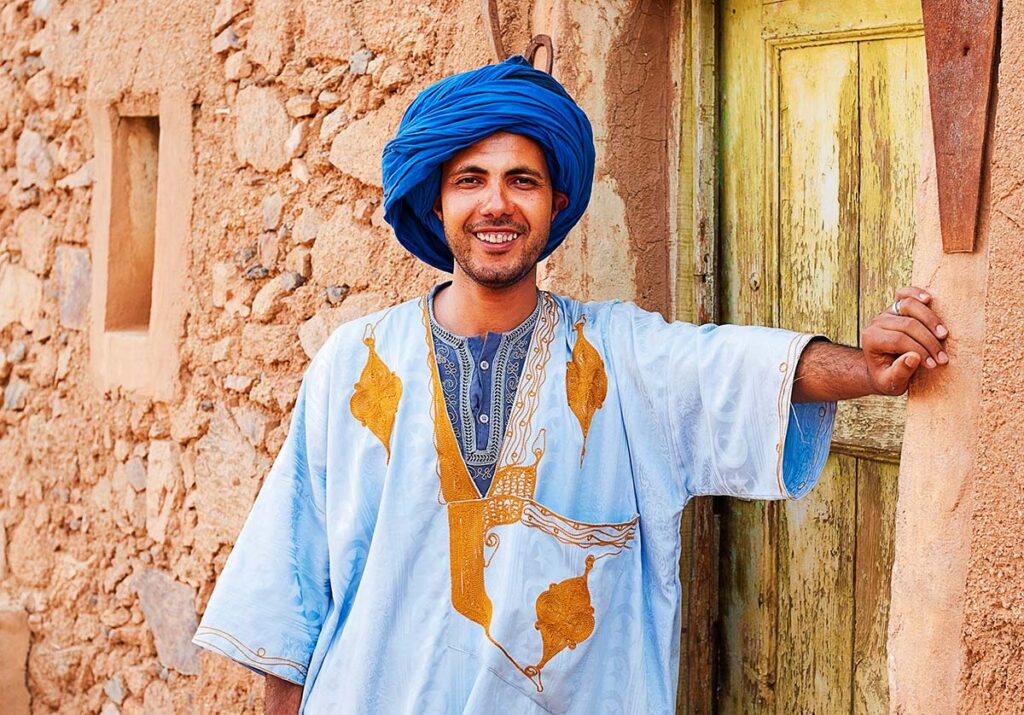
Morocco’s people are Amazigh and Arab, and most are both. The Amazigh — “the free people,” the Berbers of the guidebooks — were here before the Arabs arrived in the 7th century, and their languages are still spoken by perhaps a third of the country: Tashelhit in the High Atlas, the Souss, and the south, Tamazight in the Middle Atlas, Tarifit in the Rif. The Arab centuries gave Morocco its religion, its cities, and Darija — the Moroccan Arabic that is the language of the street and that no other Arab understands without effort; the French Protectorate left French as the second language of business, signs, and schooling. Since the 2011 constitution Tamazight has been an official language beside Arabic — it’s the third script, Tifinagh, on every public building — and since 2024 the Amazigh New Year, Yennayer, on 14 January, is a public holiday. Two words to get right: “Berber” is the word visitors know, from the Greek for foreigner, and Moroccans will understand it; “Amazigh” is the word they use for themselves, and using it is noticed. The regions keep their characters — the Fassi of Fes, the Soussi traders of the south, the Riffians of the north, the Sahrawis of the desert — and the whole story, from the Almoravids to the mountain villages you’ll visit, is in our guide to the Berbers of Morocco.
The Greeting — A Minute That Means Everything
Nothing in Morocco starts without a greeting, and a greeting is not one word. Salam alaikum — peace be upon you — and the reply, wa alaikum salam; a handshake, light rather than firm, and then the right hand to the heart, which is the sign that the greeting was meant. Then the questions, in a stream, each answered before the next: how are you, labas? — fine, al-hamdulillah; and your family, and your health, and your children, and the journey? The exchange can run a full minute between acquaintances and nobody shortens it, because the questions are the point: they say “you are a person to me before you are a customer.” Between men a handshake, often held; between women a handshake and two kisses among friends; between a man and a woman, a handshake if she offers her hand, and a hand to the heart and a nod if she doesn’t — let her decide. A shopkeeper greeted properly gives a better price; a driver greeted properly is a friend for the day; a village greeted properly opens its doors. Learn salam, labas, al-hamdulillah, and the hand to the heart, and you have the key.
Hospitality — Tea, the Home, and What to Bring
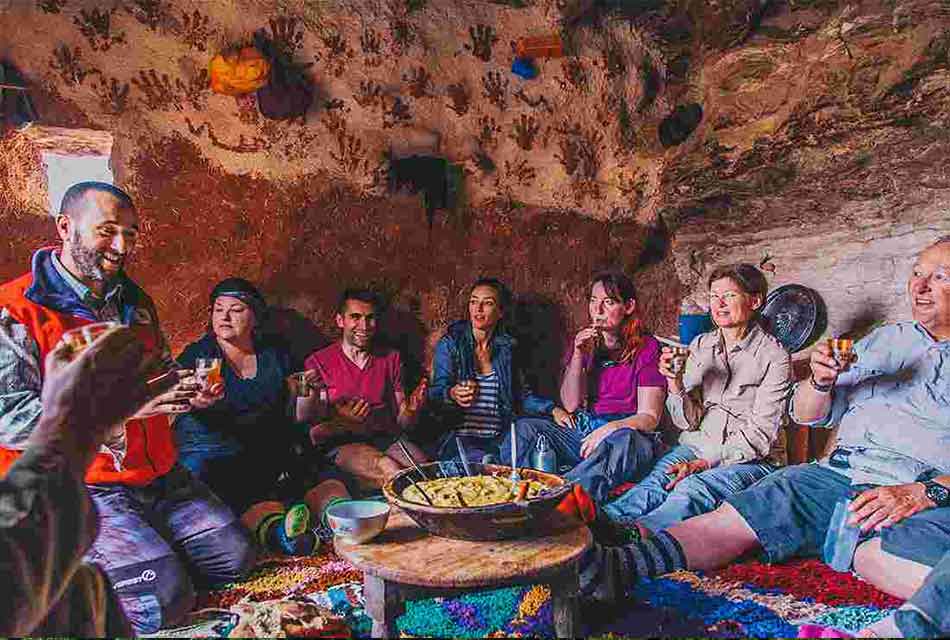
Hospitality is not a courtesy here; it’s an obligation with a thousand years behind it — the guest as a gift from God, the host measured by the welcome. The tea is where it begins: mint tea is offered in every shop, riad, office, and home, and refusing the first glass is a small rudeness; accept it, let the host pour — never pour it yourself if a host is present — and drink at least one of the three. (The three glasses have a proverb: gentle as life, strong as love, bitter as death; the whole ritual is in our Moroccan food guide.)
An invitation home is the real thing, and it will come — from a driver, a shopkeeper, a family on a train. Accept. Bring something: pastries from a good bakery, a box of dates, fruit, sugar cones or tea in the countryside; never alcohol, and nothing expensive, which embarrasses. Take your shoes off at the door, or where the family’s shoes are. Greet everyone in the room, the oldest first. Wash your hands when the basin and the kettle come round, before and after the meal, and say bismillah when you start if your hosts do. You will be fed more than you can eat, served first, and pressed to continue; eat from the wedge of the shared dish in front of you, leave the meat for the host to divide, and end with shbaat — “I’m full” — and a hand on the heart, which is the only refusal that works. Stay for tea after; leave with thanks to the cook, who may not have sat down; and send a photograph or a message afterward — the connection is what they wanted. The riads you’ll sleep in are the same houses with the same welcome at a price, and what to expect in one is in our riad guide.
The Body Rules — Hands, Feet, Heads, and Shoes
- The right hand: for eating, greeting, giving, and receiving — the left is for the other business of the day, and an object handed over with it is a small insult, unnoticed in a hotel and noticed in a village.
- Bread: the utensil for the shared dish, eaten from the piece in front of you, never thrown away — it’s picked up from the ground and kissed if dropped.
- Shoes: off at the door of any home, on the carpet of a mosque courtyard, and off before the rugs in a riad salon if the family’s are.
- The feet: don’t point the soles at anyone, and don’t put them on a table or a seat.
- The head: a child’s head is patted with a blessing, and nobody minds; an adult’s is not touched.
- Public affection: a couple holding hands is fine; kissing in the street is not, in the cities a little and in the villages at all; two men holding hands or arms, by contrast, is friendship and common.
- Voices: raised ones are rare and alarming; the Medina argues loudly and means nothing by it.
Mosques, Friday, and the Call to Prayer
Non-Muslims can’t enter mosques in Morocco, and the rule isn’t Islamic — mosques in Egypt, Turkey, and Tunisia admit visitors. It’s colonial: a 1912 decree of the French Resident-General, Lyautey, who closed them to Europeans to keep the Protectorate out of religious life, and independent Morocco kept it. The exceptions: the Hassan II Mosque in Casablanca, built in 1993 and open to all on guided visits (about 130 MAD; the hours and the dress are in our Casablanca guide); the Tin Mal mosque in the High Atlas, a 12th-century Almohad ruin restored as a monument; and the madrasas — Ben Youssef in Marrakech, Bou Inania and Al-Attarine in Fes — which were colleges, not mosques, and are the finest Islamic interiors you’ll see. For the rest, the courtyard glimpsed through the door, the minaret from the roof, and the Koutoubia’s gardens are the view; don’t step in, and don’t photograph the people praying.
The call to prayer comes five times a day — before dawn, midday, mid-afternoon, sunset, and night — from every minaret at once, and it’s the clock the country runs on: the shopkeeper who leaves the shop for fifteen minutes, the café that goes quiet, the driver who asks for a stop. Friday is the day: the midday prayer is the week’s great gathering, shops close from about noon to two, the Couscous follows at home, and the souks are half-open until four. Plan the Friday morning for the sights, the afternoon for a hammam or a garden, and don’t expect to shop at one.
The Hammam — The Rules of the Bath
The hammam is the neighbourhood steam bath, and every quarter has one — the social event of the week for most Moroccans, and the one place a visitor is a complete beginner. The local hammam (20–50 MAD): single-sex, by schedule — men in the morning and evening, women in the afternoon, or on alternate days; check the door. Bring a swimsuit or underwear (nudity is not done), flip-flops, a towel, a bucket if you have one, black soap and a kessa glove from any hanout (20 MAD the pair), and a change of clothes. Inside: three rooms from warm to hot; take a bucket, fill it from the taps — hot and cold mixed yourself — sit, sweat, soap, and when you’re ready, the attendant (the kessal or kessala, 50–100 MAD) scrubs you with the glove until a grey roll of skin comes off, which is the point.
The tourist hammams (150–400 MAD) do the same with a robe, a private room, mint tea, and no schedule — easier, less of a story. Either way, don’t eat first, drink water after, and go in the afternoon of a long day: the sleep that follows is the best in the country.
Photographs — When to Ask
People, always ask: a gesture with the camera and a raised eyebrow works in any language, and a no is a no. In the villages the women will usually say no, and that’s the end of it; the men and the children usually say yes. On Jemaa el-Fna, the performers — the Gnawa musicians, the water-sellers in their hats, the snake charmers — are the photograph and the fee: 10–20 MAD agreed before you raise the phone; the “no photo” shouted at you is the opening of a negotiation, and a photo taken without asking is followed by a demand for ten times the price. Markets, streets, doors, and architecture are free to everyone. Never: the police, the military, the gendarmerie checkpoints, the royal palaces and their guards, the airports, and anyone praying. Drones need a permit from the civil aviation authority and are confiscated at customs without one.
Hustle Versus Rudeness — Reading the Medina
The Medina’s persistence is commerce, not hostility, and the difference matters for your day. The shopkeeper who calls you in, the boy who offers to show you the way, the man who says the road is closed, the carpet seller who won’t let the conversation end — none of them are angry with you and none of them will be once you’ve said no; they’re working, and the no is part of the work. The tools: la shukran — no, thank you — with a smile and the hand to the heart; safi — enough — for the second time; keep walking, don’t stop, don’t explain; and the one thing never to do, which is to get angry, because that’s the only thing that turns the exchange sour. Real rudeness — a hand on you, a block in the lane, an insult — is rare and is answered by the shopkeepers around you, who’ll shout the offender off; the tourist police on the square exist for the rest.
The Medina on your own terms is a skill learned in a morning; our Guided Marrakech Walking Tour on your first day is three hours with a licensed guide who shows you how, and the prices, the scripts, and the method for the souks are in our Marrakech souks guide. Ramadan changes the day’s rhythm and adds one rule — nothing in the street by daylight — covered in our guide to visiting Morocco during Ramadan.
Twenty Words — Darija & Tamazight
| English | Darija (Moroccan Arabic) | Tamazight (Berber) |
|---|---|---|
| Hello / peace be upon you | Salam alaikum — reply wa alaikum salam | Azul |
| How are you? | Labas? — reply labas, al-hamdulillah | Manik antgit? |
| Thank you | Shukran | Tanemmirt |
| No, thank you | La, shukran | Uhu, tanemmirt |
| Please | Afak | — |
| Yes / no | Iyeh / la | Yah / uhu |
| How much? | Bshhal? | Mnshk? |
| Expensive | Ghali | — |
| Enough / that’s fine | Safi | — |
| Without chilli / sugar | Bla hrur / bla sukkar | — |
| Good / beautiful | Mezyan / zwin | Ifulki |
| No problem | Mashi mushkil | — |
| God willing | Inshallah | Inshallah |
| Blessed — the tea, the meal | Bismillah before, al-hamdulillah after | — |
| I’m full | Shbaat | — |
| Water | Lma | Aman |
| Bread | Khobz | Aghrom |
| Welcome | Marhba | Ansuf |
| Goodbye | Bslama | Ar tufat |
| God bless you — the reply to thanks or Eid Mubarak | Allah yabarek fik | — |
Tamazight varies by region — these are the Tashelhit forms of the Atlas and the south, where our treks and tours go; in the Middle Atlas and the Rif the words differ. French works everywhere a Darija word fails; English is common in the cities and the camps.
Dress — What to Wear, and Where
The principle is the place, not a rule book. In the cities’ new towns, the hotels, and the beach resorts, what you’d wear at home is fine — Marrakech’s Gueliz is as short-sleeved as Madrid. In the Medinas, the villages, the souks, and anywhere near a mosque: shoulders and knees covered for everyone, loose rather than tight, and for women a scarf in the bag for the moment it’s wanted — not required anywhere, appreciated near shrines. On a desert tour or a trek: long, light layers for the sun and the cold, and the villages’ standards. Swimwear is for the pool and the beach, and a cover-up for the walk between.
Tipping — In Dirhams
| Situation | What to give |
|---|---|
| Restaurant | 10%, or round up a small bill |
| Café | A few dirhams; round up |
| Hotel or riad porter | 10–20 MAD a bag |
| Riad staff, at the end | 50–100 MAD a stay, in the box or to the manager |
| Tour guide | 100–150 MAD a day, for the group |
| Driver, multi-day tour | 100–200 MAD a day, for the group |
| Driver, day trip | 30–50 MAD |
| Camel handler, camp crew | 20–50 MAD a person |
| Hammam attendant | 20–30 MAD |
| Petit taxi | Round up to the next 5 |
| Mosque or shrine guardian, cemetery caretaker | 10–20 MAD |
| A performer photographed | 10–20 MAD, agreed first |
Tip in dirhams, in notes: coins and euros are both awkward for the person receiving them. Tipping is expected and small, part of how the economy works rather than a reward for excellence; carry the 10s, 20s, and 50s for it, and give with the right hand.
The Culture on Our Tours — Where You’ll Meet It
Every tour we run is a day among Moroccans rather than a day looking at them. The camps at Merzouga are run by Aït Khabbash families, and the drumming after dinner is theirs; the village of Khamlia beside the dunes is Gnawa — the descendants of enslaved West Africans whose music is a healing rite — and the 4-day tour stops for it; what the dune town holds is in our Merzouga guide. The treks sleep in village gîtes and family houses: the 3-Day Atlas Valleys Trek through the Azzaden and Imlil valleys, and the 5-Day Toubkal Summit and Berber Villages Trek, with the mountain’s families as hosts and the muleteers as company. The day trips put you at a Berber house in Ourika for tea and the bread oven, at the Monday souk, at the fish grills of Essaouira, in the Medina with a licensed guide. The rules on this page are the ones our guides and drivers live by, and they’ll show you the rest.
Safety, Women, and LGBTQ+ Travellers — The Short Version
Morocco is safe for visitors: the risks are petty theft and persistent hustle, not violence, and the habits on this page handle most of it. Women travelling alone report attention rather than danger — comments in the Medina, a persistent stranger — and the tools are the same: modest dress, a firm la shukran, a shop doorway or a café if someone won’t take it, and the ordinary rules about late nights and empty lanes; Moroccan women are everywhere in the streets, which is the cue. Same-sex relations are illegal under Article 489 of the penal code and the law is rarely applied to visitors; the honest advice for LGBTQ+ travellers is discretion in public — which is the rule for every couple here — and no concern at all in the riads and hotels, many of which are gay-owned. The neighbourhood-by-neighbourhood detail, the scams by script, and the emergency numbers are in our Casablanca safety guide, which applies to every city.
Greet first: Salam alaikum, a handshake, the hand to the heart, and the questions — a minute that opens every door.
Tea and the home: Accept the first glass, let the host pour, take your shoes off, bring pastries, end with shbaat and a hand on the heart.
The body: Right hand, bread as the utensil, soles down, the head untouched, affection private.
Mosques: Closed to non-Muslims since 1912 — except Hassan II, Tin Mal, and the madrasas; five calls a day; Friday noon to two.
The hammam: Single-sex by schedule, bring the kit, 20–50 MAD local, don’t splash.
Photos: Ask; 10–20 MAD for a performer; never the police or the palace.
The Medina: Hustle is commerce — la shukran, safi, keep walking, never angry.
Tips: Dirhams, in notes — 10%, 100–150 a day for a guide, 50–100 for a driver.