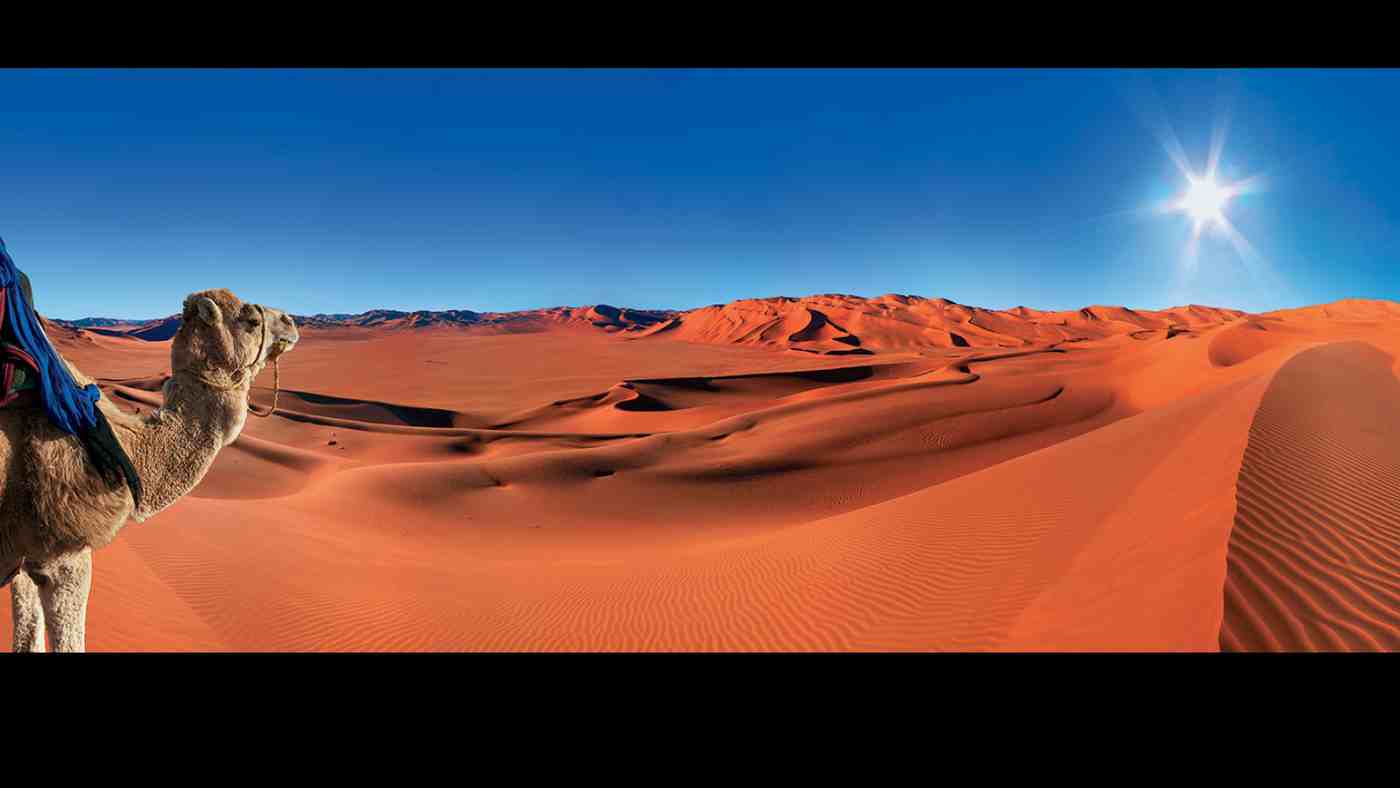
The best things to do in Merzouga: 1. A sunset camel trek across Erg Chebbi (included in every tour, from €95). 2. Sunrise from the top of the dunes. 3. Khamlia village — live Gnawa music. 4. Sandboarding down the dunes. 5. A night at a desert camp under the stars. Merzouga is 560 km from Marrakech — most visitors arrive on a 3-day desert tour; every option is in the cost table below. Best months: March–May and September–November.
The 17 Best Activities
1. Camel Trek Across Erg Chebbi

The defining Merzouga experience. A one-hour camel ride into the heart of the Erg Chebbi dunes — towering orange sand up to 150 metres high — to a desert camp for sunset, dinner, Berber drumming, and a night under the stars, with a second ride back at sunrise. Included in every Marrakech Desert Trips, shared or private.
2. Sunrise & Sunset from the Dunes

Climb a dune before dawn and watch the Sahara transform: deep purple to gold to blazing orange in minutes. Sunrise is usually more dramatic than sunset — the light hits the dune ridges at sharper angles — and both are part of every overnight camp stay. Bring a wide-angle lens, and a layer: the dunes are cold before the sun arrives.
3. Khamlia Village — Live Gnawa Music

A small village 7 km from Merzouga, home to descendants of sub-Saharan Africans who keep the hypnotic Gnawa tradition alive — drums, iron castanets, and call-and-response chants with Sufi roots, inscribed by UNESCO as intangible cultural heritage in 2019. Tea with the community and an intimate performance. Included in local 4×4 excursions and in our 4-day Merzouga tours, which spend a whole day here.
4. Sandboarding on Erg Chebbi

Slide down the dunes on a board — free at every camp we use. No experience needed, and the sand is forgiving. Best in the late afternoon once the surface has cooled; sitting is easier than standing and just as fun. Expect sand in places you didn’t know you had.
5. Stargazing in the Sahara

The Milky Way is plainly visible from the Merzouga camps: near-zero light pollution, dry air, and the horizon-to-horizon sky of the erg make this one of the best stargazing spots in North Africa. New moon nights are darkest; the camps lay out blankets on the dunes, and some luxury camps run guided sessions. Winter gives the clearest skies of all.
6. 4×4 Desert Tour

A half-day 4×4 excursion covers what camels can’t: fossil beds, the abandoned M’Ifis mines, nomadic families, Khamlia village, and Dayet Srji Lake, where flamingos appear in wet years. Around €25 per person booked locally, or as a buggy or quad option (about €40–50). Your driver-guide can arrange it on any tour that spends a full day in Merzouga.
7. Meet Nomadic Berber Families
The 4×4 circuit stops at the tents of real nomadic families still moving with the seasons across the hamada. Share mint tea, see how a household packs into a camel’s load, and hear how they read the weather. A small gift or a purchase of their weaving is the courteous way to say thanks — a humbling, unscripted encounter you won’t find in a guidebook.
8. Discover Fossils & Ancient Sea Beds

The Sahara was an ocean 350 million years ago, and trilobites, ammonites, and orthoceras surface throughout the region. See them in the rock on a 4×4 stop, or browse the workshops of Erfoud and Rissani on the way in, where black marble slabs are cut and polished to reveal them. Ethically sourced specimens make the most unusual souvenir in Morocco.
9. Traditional Saharan Cuisine
Medfouna — “Berber pizza,” a stuffed bread baked under hot sand — lamb or chicken Tagine with local spices, Berber omelette for breakfast, and endless mint tea. Camp dinners and breakfasts are included on every tour; lunches on the road are yours to choose. Ask your camp about cooking a medfouna with the staff — most will say yes.
10. Dayet Srji Lake & Flamingos

A seasonal lake near Hassilabied that fills after rain. When there’s water, flamingos, herons, and migrating birds arrive — a surreal sight against the dunes behind. Included on most 4×4 circuits; best in winter and spring, when levels are highest. In a dry year it’s a salt pan with a view, so ask before you go.
11. Explore Rissani — Desert Market Town

Thirty-five kilometres from Merzouga, Rissani is the old caravan hub and birthplace of the Alaouite dynasty, Morocco’s ruling family. The souk runs on Tuesdays, Thursdays, and Sundays — dates, spices, donkeys, and not a tourist stall in sight — beside the Mausoleum of Moulay Ali Cherif and the ruined ksar. Every Marrakech-to-Merzouga tour passes through it on the way in.
12. Desert Bonfire & Berber Music
Every camp ends the evening around a fire: Berber drumming, call-and-response singing, dancing if the group is willing, and mint tea passed around while the stars come out. Included in every overnight stay. The sound of drums in the Sahara silence is the thing people describe first when they get home.
13. Sand Bath Therapy
A traditional summer cure: you’re buried in hot sand up to the neck for ten to fifteen minutes, which locals swear by for joint pain, rheumatism, and skin conditions. Offered in Merzouga from June to August, when the sand is hottest — the one activity for which the Saharan summer is the point rather than the problem. Drink water before, during, and after.
14. Hassilabied Oasis
A village tucked behind the dunes with a lush palm oasis — an improbable splash of green at the edge of the Sahara. Stroll the palm groves, follow the khettara irrigation channels that have watered this ground for centuries, and meet the families who farm it. A quiet counterpoint to the dunes, twenty minutes’ walk from the camps.
15. Attend a Local Festival
Merzouga and the villages around it host music gatherings through the year — Gnawa evenings in Khamlia, Berber celebrations at harvest and weddings, and an international festival that brings Saharan and visiting musicians to the dunes, usually in spring. Dates move; ask us or your camp what’s on during your stay.
16. Visit Galerie Laoun
A small gallery in Merzouga showing desert-inspired paintings, Berber jewellery, and textiles by local artists. Worth a half-hour stop and the best place in the village to buy something made here rather than shipped in — your purchase goes directly to the maker.
17. Luxury Desert Spa

The premium camps add Hammam treatments, massages, and even plunge pools among the dunes. After a day of camel riding and sandboarding, a desert Hammam is the ideal way to end it. Available at the top-tier camps only — the luxury camp guide above lists which ones.
How to Get to Merzouga
From Marrakech (560km, 9–10h): Most visitors come on a 3-day desert tour, shared or private, with the 4-day version adding Skoura, Todra Gorge, and the Draa Valley at a slower pace — all priced in the table below. The road crosses the High Atlas, stops at Aït Ben Haddou, and runs through the Dades Valley; the journey is half the experience.
From Fes (450km, 7–8h): Via the Middle Atlas cedar forests and the Ziz Valley, with Merzouga reached on the first evening. The one-way crossings between Fes and Marrakech put a Sahara night in the middle and spare you the backtracking.
By bus: Supratours/CTM from Marrakech to Errachidia (7h), then local transport to Merzouga (2h). Budget option but long.
By air: Fly to Errachidia (Moulay Ali Cherif Airport) from Marrakech and Casablanca, then two hours by road to Merzouga.
Best Time to Visit Merzouga
Spring — Mar to May
25–35°C days, 12–20°C nights. Perfect camp weather, clear skies, roses and wildflowers in the Dades on the drive. April is peak.
Autumn — Sep to Nov
25–32°C days, 10–18°C nights. Post-summer calm, fewer crowds. October is the second most popular month.
Summer — Jun to Aug
40°C+ by day, warm nights. Tours run daily with early starts and air-conditioned tents (+€65 shared, +€20 private); the dunes are only pleasant at dawn and dusk. Sand-bath season.
Winter — Dec to Feb
18–22°C days, 0–5°C nights. Pleasant by day, freezing at camp — the heated luxury tent earns its price. The clearest skies of the year for stargazing.
What Does It Cost?
| Option | Duration | From | Includes |
|---|---|---|---|
| Shared 3-Day Marrakech to Merzouga | 3 days | €95 | Minibus, comfortable camp, meals, camel treks |
| Private 3-Day Marrakech to Merzouga | 3 days | €195 | Private 4×4, luxury camp, meals, camel treks |
| Private 4-Day Marrakech to Merzouga | 4 days | €275 | 4×4, Skoura, Todra, Draa Valley, luxury camp |
| Private 4-Day Marrakech to Fes via Merzouga | 4 days | €315 | One-way, a full desert day, Khamlia, lodge + camp |
| Private 3-Day Fes to Marrakech via Merzouga | 3 days | €225 | One-way, dunes on night one, luxury camp |
| Local 4×4 excursion | Half day | ~€25 | Khamlia, nomads, fossils, lake |
| Quad biking | 2 h | ~€30 | Quad, guide, helmet |
| Sandboarding | — | Free | Included at camp |
What to Pack
Essentials: Light layers, a warm jacket (desert nights drop 15–20°C from the daytime high), sun hat, sunglasses, SPF50, a scarf or buff for sand and wind, closed-toe shoes, and a headlamp for camp.
Tech: a camera with a wide-angle lens, a power bank, and a phone with a working SIM card — signal is patchy between Erfoud and the dunes.
Winter extras (Dec–Feb): A thermal base layer, a sleeping-bag liner, gloves. Camp nights touch 0°C.
Full checklist: What to Pack for a Morocco Desert Tour.
#1 activity: The sunset camel trek and overnight camp, included in every tour from €95.
Don’t miss: Khamlia’s Gnawa music, sunrise from the dunes, stargazing.
Getting there: A 3-day tour from Marrakech (from €95 shared, €195 private) or a one-way crossing to or from Fes.
Best months: March–May and September–November; summer runs with AC tents and early starts.
Camp: Comfortable camp included on shared tours, with upgrades; luxury ensuite standard on private tours.