Mount Toubkal Trek 4 Days
The most prepared you can be for 4,167 metres. Four days based at the Toubkal Refuge (3,207m) — three nights adjusting to altitude, a dedicated acclimatization day climbing the Ouanakrim twin peaks, and a summit push when your body is truly ready. This is the steady climber's Toubkal — no rushing, no village detours, just focused altitude preparation and the summit. The best format for winter ascents when conditions demand extra time and flexibility. Licensed guide, mule support, 3 nights at the refuge, all meals. From €250/person.
Give yourself the best odds of standing on North Africa's highest peak on the 4-day Mount Toubkal trek — the most thorough summit preparation we run. You spend 3 nights at the Toubkal Refuge (3,207m) with a dedicated acclimatization day climbing the Ouanakrim twin peaks before the summit push. Day 1: Imlil to the refuge via Sidi Chamharouch (5–6h). Day 2: the Ouanakrim climb from the refuge. Day 3: summit 4,167m, return to the refuge. Day 4: descend to Imlil, drive to Marrakech. The extra day doubles as a weather buffer — if Day 3 isn't safe, you summit on Day 4 — which is why it's the format we recommend for winter ascents. Licensed guide, mule, all meals. From €250/person. The winter-ready ascent among our Atlas Mountains treks.
Route Statistics
Moderate-Challenging · With Altitude Acclimatization · Winter Ready
The extra acclimatization day at 3,207m makes the summit significantly more achievable. You spend 2 full days at the refuge before attempting 4,167m — your body is as prepared as it can be. Day 1 is the approach. Day 2 is altitude training on Ouanakrim. Day 3 is summit day. Day 4 is the descent. In winter, this format gives you a weather buffer — if Day 3 conditions are bad, you can attempt Day 4 instead. Good fitness required. Winter: crampons + ice axe mandatory.
At a Glance
Tour Highlights
The Summit — 4,167 Metres, Fully Acclimatised
Reach the highest point in North Africa on Day 3 after two full days at altitude — the gentlest summit morning of any Toubkal format, with the Sahara and the Marrakech plain on either horizon.
DAY 3The Ouanakrim Climb
Day 2's altitude training: a 5–7 hour round trip toward the massif's second-highest peaks, Ras and Timesguida, with Toubkal in view from a new angle and your body learning what 4,000 metres feels like.
DAY 2Built for Winter
From November to April the upper mountain is snow and ice — crampons, ice axe, -20°C on top — and the 4-day's extra night is what makes a winter summit safe rather than hopeful.
NOV–APRThe Weather Buffer
Three nights at the refuge mean the summit can be attempted on Day 3 or Day 4. A storm on the first morning costs you a day, not the mountain — the format's quiet advantage.
DAY 3 OR 4Three Nights at the Refuge
Base yourself at 3,207 metres in a stone mountain hut — dormitories, blankets, a fireplace lounge, hot meals from your cook — and climb from there, with no village detours.
NIGHTS 1–3Licensed Guide & Mule Team
A bilingual mountain guide who reads the forecast each evening, checks your gear in Imlil, and sets the pace for the altitude — with mules carrying your luggage to the refuge.
INCLUDEDPhoto Gallery


Trek Itinerary
Four days from Marrakech to the summit of Toubkal, the winter-ready way. The Ait Mizane approach, three nights at the refuge, the Ouanakrim acclimatization climb, a built-in weather buffer, and 4,167m — the roof of North Africa.
Pickup from your Marrakech hotel. A scenic 90-minute drive into the High Atlas to Imlil (1,740m). Meet your licensed mountain guide and mule team. Before setting off, your guide checks your hiking gear for the season — boots, layers, and in winter crampons and an ice axe — and, if anything is missing, helps you rent it from the Imlil shops.
Trek through the Ait Mizane Valley — terraced fields, walnut groves, and the stone houses of Aremd village stacked up the hillside — to the whitewashed shrine of Sidi Chamharouch (2,310m) beside its waterfall. Picnic lunch here. The valley narrows above the shrine and the trail switchbacks steadily up through scrub and rock, the air cooler with every hour, to the Toubkal Refuge (3,207m) — Les Mouflons or Club Alpin. Dormitory accommodation, dinner from your cook. Settle in — this is your base for the next 3 nights.
This is the day that sets the 4-day apart. After breakfast at the refuge, climb toward the Ouanakrim twin peaks — Ras Ouanakrim (4,083m) and Timesguida (4,089m), the second-highest summits of the massif, visible from the refuge door. A 5–7 hour round trip on rock and, in winter, snow, with the Toubkal summit in view the whole way from a different angle. The climb tests your body at high altitude without the pressure of the main summit, and tells you — and your guide — exactly how you're coping before tomorrow's push.
Return to the refuge for dinner and your second night at 3,207m. By now your body has spent two full days adjusting to altitude. You know how you feel at height. You know if your gear works. You're as prepared as any trekker on the mountain. Rest well — tomorrow is summit day.
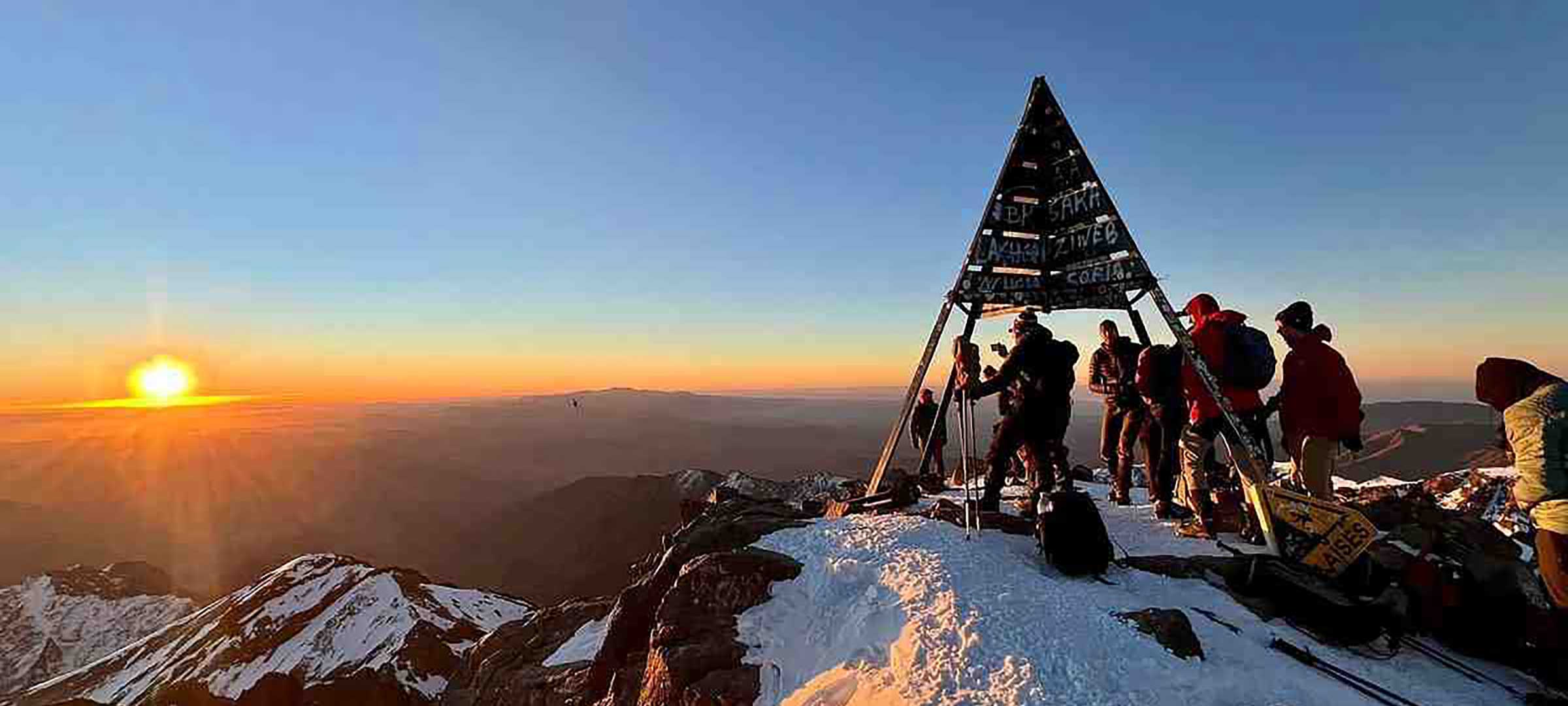
Early start. The route follows the south cirque — scree and boulders in summer, packed snow and ice in winter (crampons + ice axe). After 2 days at 3,207m, your body is well-acclimatized. 3–4 hours to the summit — 4,167 metres. The iconic triangular marker. 360° views over the Atlas Mountains, the Sahara, and the Marrakech plain. ~45 minutes on top.
Descend to the refuge for lunch and your third night. There's no need to go all the way down to Imlil today: you rest at the refuge — recover, celebrate, and prepare for tomorrow's easy descent. If the weather kept you off the summit this morning, this is the day held in reserve.
After breakfast, descend at a relaxed pace — past Sidi Chamarouch shrine and through the Ait Mizane Valley back to Imlil (1,740m). Lunch in Imlil. Your driver is waiting for the transfer back to Marrakech — arriving with the evening free. Four days. One summit. Maximum preparation. Trek complete.
Summer vs Winter
Summer / Dry Season
Excellent conditions. Dry trails, clear views. Standard hiking gear. The Ouanakrim acclimatization day is a bonus even in summer — more prepared = more enjoyable summit. Long daylight hours for comfortable climbing. For month-by-month conditions across Morocco, see our guide to the best time to visit Morocco.
Winter / Snow Season — Recommended Format
This is the trek designed for winter. Crampons + ice axe mandatory — rentable in Imlil, and your guide checks your kit before you set off. Snow covers the upper mountain. The extra day gives you a weather buffer — if Day 3 conditions aren't safe, you attempt the summit on Day 4 instead. Temperatures to -20°C at altitude.
Trek Prices
| Participants | 1 | 2 | 3 | 4 | 5 | 6 | 7–9 | 10–13 | 14–17 |
|---|---|---|---|---|---|---|---|---|---|
| Price / person | 575€ | 340€ | 330€ | 310€ | 295€ | 280€ | 270€ | 260€ | 250€ |
Prices verified March 2026
Inclusions & Exclusions
✓ Included in Your Tour
- Round-trip transfer Marrakech ↔ Imlil (A/C)
- Licensed bilingual mountain guide
- Mule support for luggage
- 3 nights at Toubkal Refuge (dormitory)
- Ouanakrim acclimatization day (Day 2)
- All meals — full board (all 4 days + water)
Not Included
- Personal hiking gear (rentable in Imlil)
- Winter equipment — crampons & ice axe (~€5/day each)
- Personal expenses & snacks
- Tips for guide & mule team (optional)
- Travel insurance (strongly recommended)
Know Before You Go
Gear Check in Imlil
Your guide inspects boots, layers, and winter kit before the walk starts and helps you rent anything missing from the Imlil shops — crampons and ice axe at about €5 a day each. Winter kit is mandatory, not optional.
Three Nights at 3,207m
The refuge is a stone hut with shared dormitories, blankets, a fireplace lounge, and limited electricity. Bring earplugs, a sleeping-bag liner, and a power bank; by the third night most people sleep well.
How the Weather Buffer Works
Your guide decides each evening whether tomorrow is summit day. If Day 3 isn't safe, you rest or climb again and push for the top on Day 4 — then descend to Imlil the same afternoon.
Altitude
Two full days above 3,200 m before the summit is the point of this trek, but the rules still hold: drink constantly, eat even without appetite, and tell your guide the moment a headache starts.
Best Season
This is the winter format — November to April on snow with crampons, with the buffer day earning its place. May–June and September–October bring dry trails and an easier climb; summer is hot below, fine above.
What to Carry
Mules take your main bag to the refuge; you walk with a daypack — water, snacks, sun protection, a warm layer, headlamp, camera. Everything else stays in your refuge bunk for the three nights.
Traveller Reviews
314 verified reviews
"The Ouanakrim day was the smartest decision. By summit morning I felt completely adjusted — no headache, no nausea, just confidence. The sunrise from 4,167m in winter was the most spectacular thing I've ever seen. Our guide was exceptional at reading the weather and conditions. Worth every extra day."
"We did this in January — full winter conditions. Crampons, ice axe, -15°C at the summit. The 4-day format was essential. Day 3 had bad weather so our guide moved the summit to Day 4 instead. Without that flexibility we wouldn't have made it. The sunrise summit was unforgettable. Professional and safe."
"This was my first big mountain and I'm so glad I chose the 4-day. The Ouanakrim climb on Day 2 showed me I could handle the altitude. The refuge is basic but the lounge has a fireplace and the food was surprisingly good. Summit day felt manageable because I'd had time to adjust. Highly recommend this format."
"The 4-day is the way to go if you're serious about summiting. The 2-day is too fast for most people. The 3-day goes through valleys you don't need if your goal is the peak. The 4-day gives you what matters: time at altitude, an acclimatization climb, and a weather buffer. Our guide Mohamed made it perfect."
"Booked the 4-day specifically for winter. The crampons and ice axe were rented in Imlil for almost nothing. The snow made the climb harder but more beautiful. Standing at the summit marker with snow everywhere and the sun rising — I'll never forget it. The extra acclimatization day was absolutely the right call."